
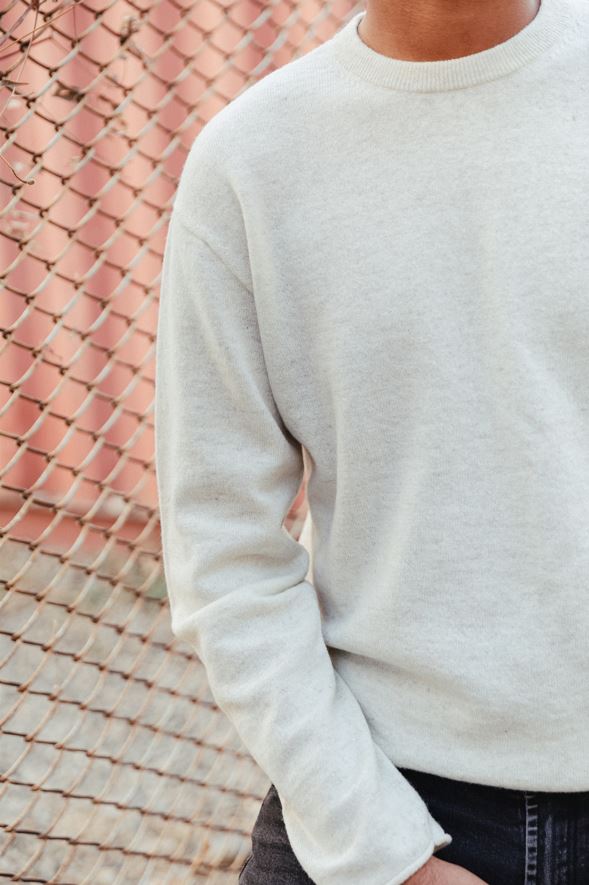
Ten steps, several specialists, close to four hours.
The price of a cashmere sweater is set long before it reaches a shelf. It comes from the yarn, and from the hours of skilled work between a tech pack and a finished, folded garment.
A plain crew neck looks simple. Behind it are at least ten steps and several specialists, each with their own know-how. This guide follows a fully fashioned cashmere crew neck through our ateliers in Mongolia, step by step, with the approximate time each stage takes.
Once a style is developed, a basic sweater takes close to four hours of hands-on work. If you are a brand comparing quotes, this is what you are paying for.
Fully fashioned vs cut and sew
There are two ways to make a knitted sweater, and the difference shows in the cost, the waste and the way the garment ages.
In cut and sew, the machine knits a large piece of fabric. Pattern pieces are then cut out of it and sewn together, like a woven shirt. The offcuts are lost, and the cut edges must be overlocked to stop them unravelling.
In fully fashioned knitting, each panel (front, back, sleeves) is knitted directly to its final shape. The machine adds and drops stitches to form the armholes, the neckline and the cuffs. Nothing is cut, so almost no yarn is wasted. With cashmere, that matters.
| Fully fashioned | Cut and sew | |
|---|---|---|
| Yarn waste | Near zero, panels knitted to shape | Offcuts lost after cutting |
| Seams | Linked stitch by stitch, flat and elastic | Sewn and overlocked, thicker and stiffer |
| Durability | Edges stay intact, no fraying | Cut edges can weaken over time |
| Look | Visible fashioning marks, a sign of quality | Clean but flatter construction |
| Set-up | Longer: each size needs its own program | Faster: one fabric, several patterns |
| Typical use | Luxury and premium knitwear | Fashion and volume knitwear |
At HYPECHASE, we work fully fashioned only. It takes longer to set up, but for a fiber as precious as cashmere, it is the only approach that respects the material.
10
steps from tech pack to packing
3h50
of hands-on work per basic sweater
50
units per style to start production
The steps, one by one
Ten steps from tech pack to packing. The first three happen once per style. The other seven happen for every single sweater.
01
Tech pack and measurements
Sketches, measurements per size, stitch references, yarn and colour. The clearer the tech pack, the fewer sample rounds.
Once per style
02
Technical translation
A knitwear technician turns each measurement into stitch counts, row counts and shaping for every panel and size, and calculates the yarn per piece.
Once per style
03
Machine programming
A programmer writes the program for the flat knitting machine, one program per size. This is where a fully fashioned garment is really designed.
Once per style, all sizes
04
Knitting the panels
Front, back and sleeves are knitted to their final shape, then checked for faults. A flaw caught here costs minutes; after linking, it costs a garment.
90 min · basic sweater
05
Inspection and mending
Panels are inspected against the light. Small faults, such as a dropped stitch, are repaired by hand.
20 min
06
Linking
Panels are joined loop onto loop, stitch by stitch. One of the most skilled jobs in knitwear.
60 min
07
Washing
Italian soaps, filtered water and a light hand. The step that defines the softness, detailed below.
30 min per batch, plus drying
08
Pressing or steaming
The garment is shaped to its final measurements. Pressed too hard, cashmere goes flat; some brands ask for steam only. We agree this with each client.
30 min
09
Final quality control
Every piece is checked twice, by two people: measurements, symmetry, seams, surface and hand-feel.
15 min
10
Labelling and packing
Labels and swing tags are attached, and each piece is folded and packed. More in our private label guide.
15 min
Spotlight
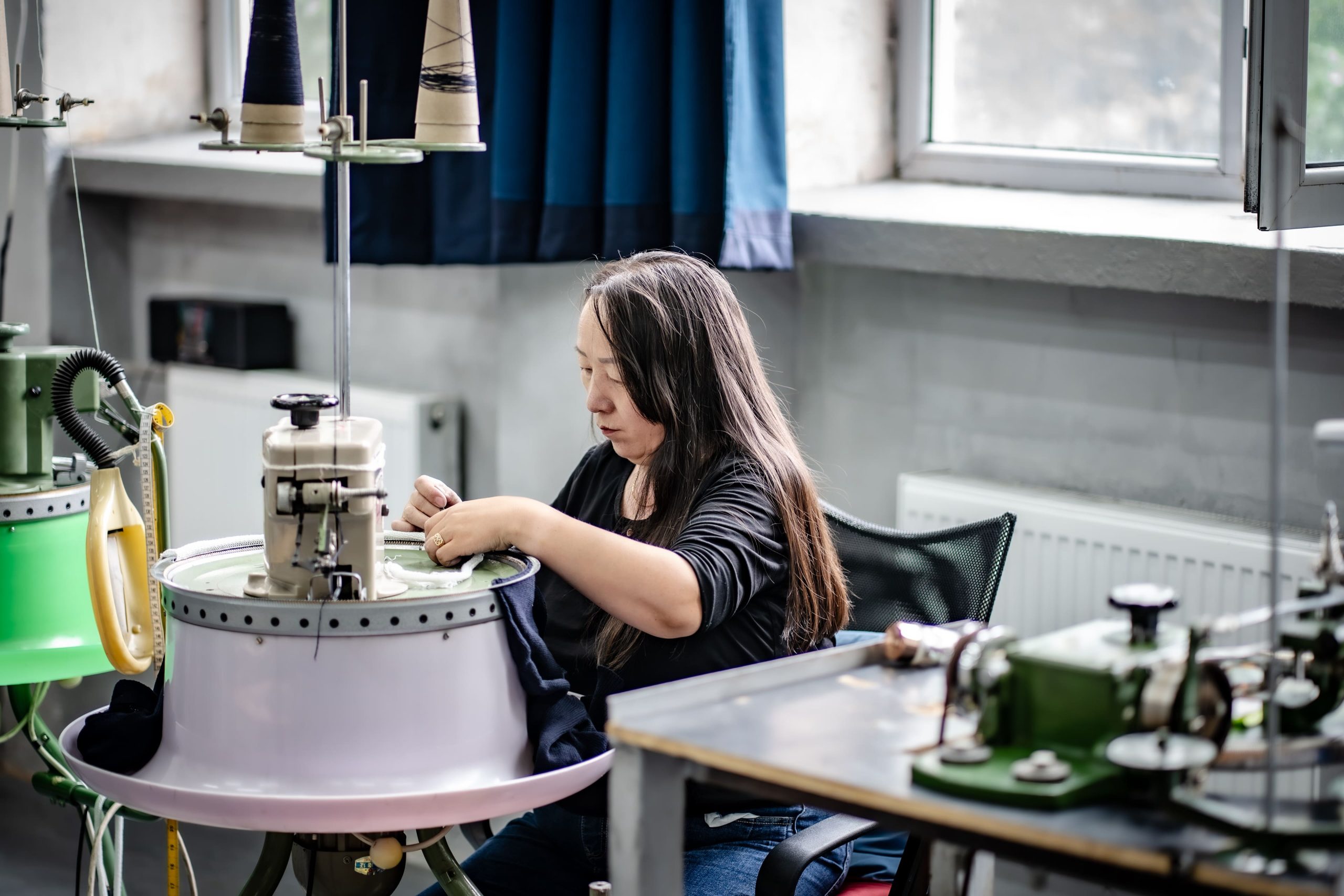
The linker
A good linker does more than join panels. They control the tension between the parts, so that the shoulder, the sleeve and the collar move together without pulling or puckering.
Too tight, and the seam loses its stretch. Too loose, and it opens. The right balance is a matter of eye and hand.
Where the time goes
For one basic crew neck, once the style is developed:
Washing is done per batch: about 30 minutes, then the pieces are laid flat to dry. Development time is shared across the whole order, which is one reason larger runs cost less per piece.
Washing: where the hand-feel is made
Straight off the machine, cashmere feels firm and slightly oily. Washing opens the fibers and gives the garment its softness. It is part chemistry, part craft, and it is where each atelier leaves its signature.
- Italian soapsWe import our soaps from Italy and use them with filtered water and selected softeners, in the same way in every partner atelier.
- Trained ateliersWe train each atelier that washes for HYPECHASE to follow the same method, so a reorder feels like the first order.
- A light washOur house style is to underwash slightly. The garment leaves us with a firmer hand and softens with every wear.
- Your choiceSome brands want a softer finish from day one. The wash level is a choice we make together, at sampling stage.
The shop-floor shortcut
Overwashed
- Very soft from the first touch
- A fuzzy halo of loose fibers
- Pills and thins after a few wears
Our house style
Light wash
- A firmer hand at first
- A clean, defined surface
- Softens with every wear, and lasts
There is more to it. Like every atelier, we keep a few finishing secrets of our own, refined season after season.
How to judge a well-finished cashmere sweater
Extreme softness sells. Many garments are washed hard precisely for that reason, because a buttery feel in the shop makes the sale. But softness alone says little about how long a sweater will last. Whether you are a brand reviewing a sample or a customer in a shop:
- Look at the surface. If a very soft sweater is also hairy, it has probably been overwashed. The fibers are already damaged, and pilling will follow.
- Be wary of a slippery feel. Heavy softeners can create a softness that fades after a few washes.
- Do not fear a firmer hand. A well-made cashmere sweater can feel slightly crisp at first. It will soften and relax with you, wear after wear.
- Check the seams. Linked seams are flat and elastic. Thick, overlocked seams usually mean cut and sew.
- Look for fashioning marks at the armholes and shoulders, the small signs that each panel was knitted to shape.
The best cashmere is not the softest on day one. It is the one that is still beautiful after ten winters.
Five finishing details to agree with your manufacturer
The same sweater can feel completely different depending on how it is finished. Before production, agree on these five points:
- Wash level: soft from day one, or a firmer hand that softens with wear.
- Pressing or steaming: full pressing, light pressing, or steam only.
- Linking tension: how much give you want at the shoulders, armholes and collar.
- Labels: brand label, care label and swing tag, and who supplies each.
- Packing: folding method, polybags or eco packaging.
At HYPECHASE, we settle each of these with you at sampling stage, so production matches the sample you approved.
Start your cashmere project
Developing a cashmere collection? Production starts from 50 units per style, across sizes and colours. Discover our private label service, request a sample, or read how yak compares in Yak wool vs cashmere.